Autonomous Agricultural Robot '26
Ground robot for precision farming and crop monitoring
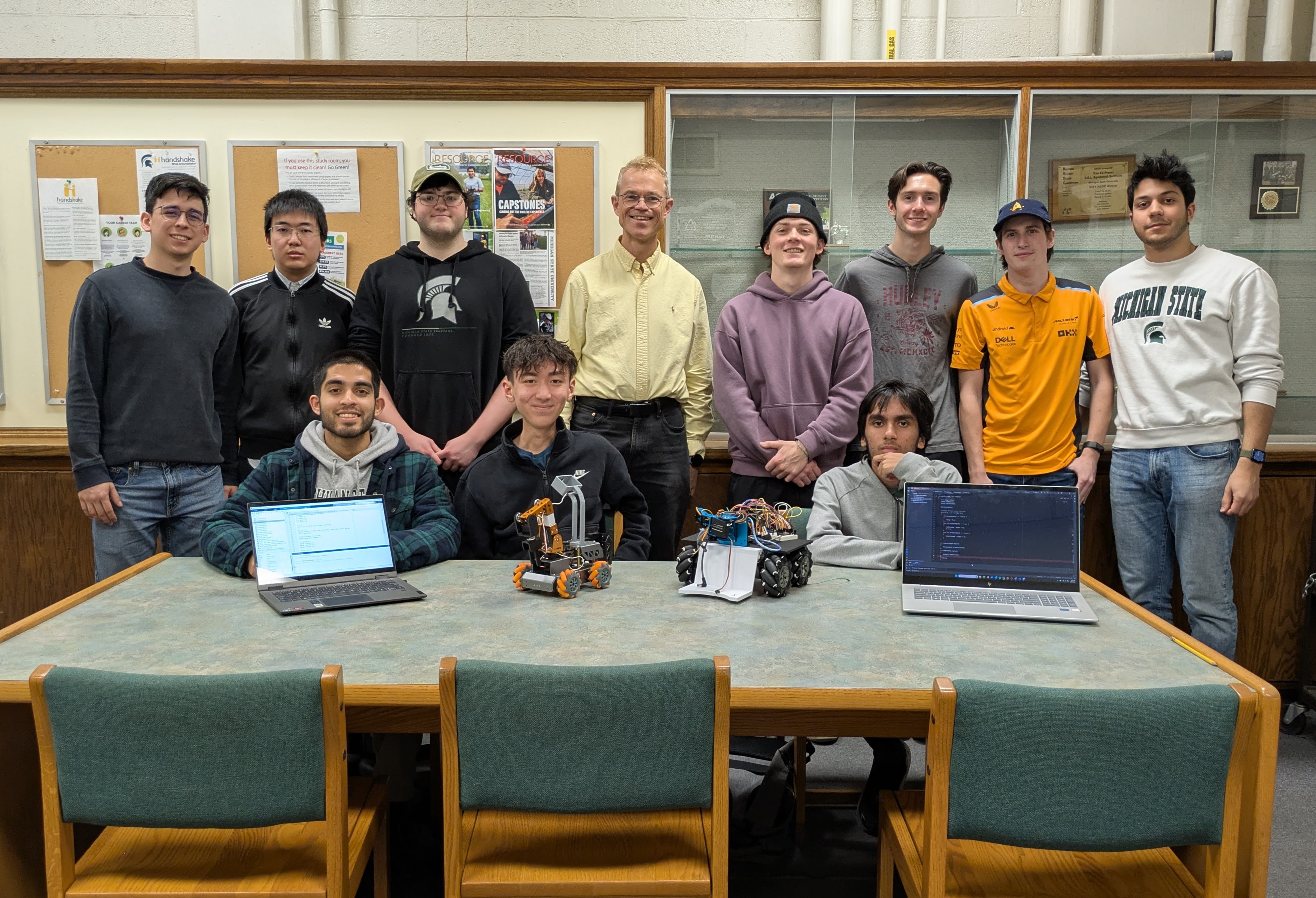
Why This Project Matters
The Autonomous Agricultural Robot is a ground-based mobile platform designed to revolutionize precision farming operations. This robot autonomously navigates agricultural fields to perform critical tasks including crop health monitoring, weed detection and mapping, soil analysis, and targeted intervention—all while reducing the need for manual labor and minimizing environmental impact.
Built on the Robot Operating System (ROS) framework, the robot integrates multiple sensor systems including GPS, LiDAR, cameras, and IMUs to achieve reliable autonomous navigation in challenging outdoor environments. The modular design allows the robot to be equipped with different tools and sensors depending on the farming task, making it a versatile platform for various agricultural applications.
The robot's navigation system combines GPS waypoint following with real-time obstacle avoidance, enabling it to traverse crop rows, avoid obstacles, and maintain accurate positioning even in areas with partial GPS coverage. Computer vision algorithms process camera data to identify crop health issues, detect weeds, and assess field conditions in real-time.
This project represents a practical application of robotics in agriculture, addressing real-world challenges faced by modern farmers while promoting sustainable farming practices through precision technology.
Workflow Features
- Autonomous GPS-based navigation with waypoint following
- Real-time obstacle detection and avoidance using LiDAR
- Computer vision-based crop row detection and following
- Weed detection and mapping for targeted intervention
- Multi-spectral imaging for crop health assessment
- Modular tool attachment system for various farming tasks
- All-terrain mobility with four-wheel independent drive
- Remote monitoring and control interface
- Data logging and field mapping capabilities
Which Tools & Stack
🔧 Mechanical Design
- Custom aluminum chassis for agricultural terrain
- Four-wheel independent drive system
- High ground clearance for crop row navigation
- Weatherproof enclosures for electronics
- Modular mounting system for sensors and tools
- Quick-swap battery system for extended operation
- Payload capacity: 20kg for sensors and implements
⚡ Hardware Systems
- NVIDIA Jetson Xavier NX for onboard computing
- RTK-GPS module for centimeter-level positioning
- 360° LiDAR for obstacle detection and mapping
- Stereo camera system for depth perception
- RGB and multispectral cameras for crop analysis
- IMU for orientation and motion tracking
- High-torque brushless DC motors with encoders
- 48V lithium-ion battery system (4-6 hour runtime)
- 4G/LTE module for remote communication
💻 Software Architecture
- ROS Noetic framework for robot control
- Custom navigation stack with GPS integration
- SLAM (Simultaneous Localization and Mapping)
- Computer vision pipeline using OpenCV
- Path planning algorithms for field coverage
- Sensor fusion for robust localization
- Web-based ground control station
- Data logging and field analytics tools
Wrinkles We Solved
GPS Reliability in Agricultural Fields
Challenge: Agricultural fields often have areas with poor GPS signal quality due to tree coverage, hills, or other obstructions. Traditional GPS-only navigation can lead to significant positioning errors and navigation failures in these areas.
Solution: Implemented an RTK-GPS system with local base station for centimeter-level accuracy. Developed a sensor fusion algorithm that combines GPS, IMU, wheel odometry, and visual odometry to maintain accurate positioning even during GPS signal loss. The system uses LiDAR-based localization as a backup when GPS is unavailable.
Impact: Achieved consistent navigation accuracy within ±5cm in open field conditions and maintained functional navigation with ±15cm accuracy even during temporary GPS signal loss. The robot can now operate reliably across the entire field without interruption.
Crop Row Detection in Varying Conditions
Challenge: Crop rows can be difficult to detect due to varying lighting conditions, crop growth stages, weeds, and soil types. Traditional vision algorithms often fail in early-season crops or during variable lighting (shadows, overcast, etc.).
Solution: Developed a robust computer vision pipeline that uses edge detection combined with Hough transform to identify crop rows. Implemented adaptive thresholding to handle varying lighting conditions. Added machine learning-based crop detection to distinguish between crop plants and weeds. The system processes multiple camera angles to improve reliability.
Impact: Achieved 94% crop row detection accuracy across different crop types and growth stages. The robot can now follow crop rows reliably from early seedling stage through full maturity, adapting to different lighting conditions throughout the day.
Power Management for Extended Field Operations
Challenge: Agricultural robots need to operate for extended periods (4-6 hours) to cover large fields efficiently. The combination of motors, sensors, and onboard computing creates significant power demands that drain batteries quickly.
Solution: Designed a high-capacity 48V lithium-ion battery system with intelligent power management. Implemented power-efficient motor control algorithms that optimize speed and torque based on terrain. Added dynamic sensor management that adjusts sensor sampling rates based on operational needs. Designed a quick-swap battery system allowing field battery changes without returning to base.
Impact: Extended operational runtime to 5+ hours under typical field conditions. The power management system reduced energy consumption by 30% compared to initial design. Quick-swap batteries enable all-day operation with minimal downtime.
Wins & Impact
The autonomous agricultural robot has demonstrated strong performance in field trials across multiple metrics:
Performance Metrics
- Navigation Accuracy: ±5cm in open field, ±15cm during GPS dropout
- Crop Row Following: 94% detection accuracy across crop types
- Obstacle Avoidance: 100% success rate in test scenarios
- Field Coverage: 2-3 acres per hour at survey speed
- Operating Time: 5+ hours on single battery charge
- Max Speed: 1.5 m/s (adjustable based on terrain)
Practical Applications
The robot has been tested for several agricultural applications including automated crop scouting, weed mapping for targeted herbicide application, and soil sampling across large fields. Initial field trials show the robot can reduce manual scouting labor by 70% while providing more comprehensive and consistent data collection.
The modular design enables the platform to be adapted for different crops and tasks, making it a versatile tool for various farming operations. Data collected by the robot provides valuable insights for precision agriculture decision-making, enabling farmers to optimize inputs, reduce waste, and improve crop yields.
This project bridges the gap between research robotics and practical agricultural applications, demonstrating that autonomous robots can be reliable, cost-effective tools for modern farming operations.